

What MSU Students Learned About Brazilian Agriculture (and the Future of American Agriculture)
July 2, 2026
By Kelsey Larson
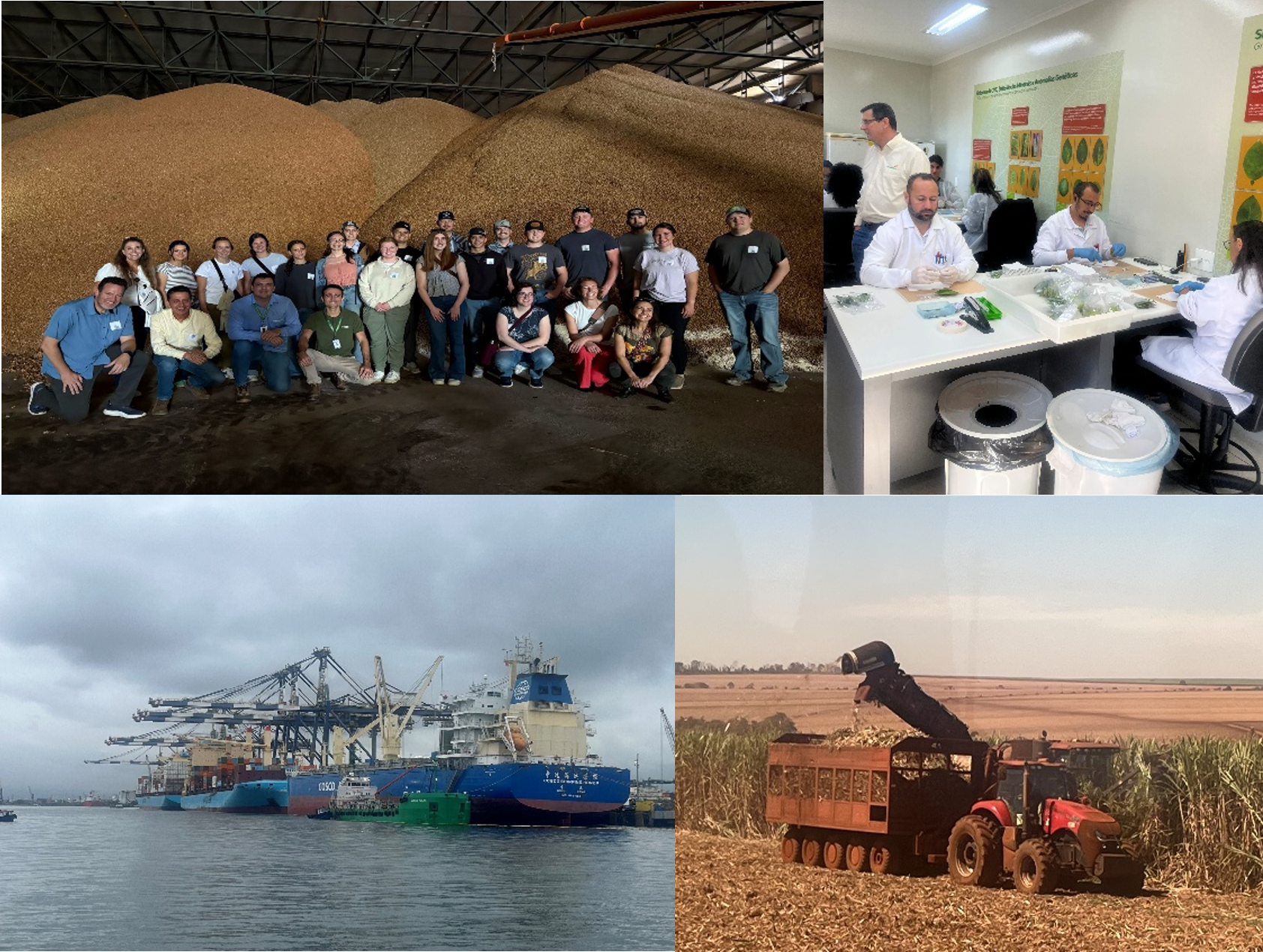 |
Source: Photos by Kelsey Larson. First Photo: MSU AGBE 315 students pose in the Coplana Peanuts warehouse. Second Photo: Scientists at Fundecitrus test citrus leaves for greening.
Third Photo: Shipping vessels load and unload in Port Santos, Brazil. Fourth Photo: A modern heavy-duty sugarcane harvester rapidly fills bins for processing into ethanol
and sugar.
MSU’s AGBE 315 (Agriculture in a Global Context) students landed in Sao Paolo, Brazil,
many in the group were stepping foot in another country for the first time. For all
of them, it was a chance to think of agriculture not just as something that happened
in the fields around their homes, but as a global project where producers around the
world solve problems, make hard choices, and buy and sell goods that shape the US
economy. Brazil is a perfect country to teach these lessons. As our students met farmers,
agribusinesses, and researchers, they were introduced to three key aspects of Brazilian
agriculture that make it particularly influential for the world.
Brazil’s first strength is its size: of its land, its economy, and its farms. Brazil is big! On our overnight flight
from Chicago to Sao Paolo, we spent nearly a third of the distance making our way
across the country of Brazil. Brazil’s land mass is similar in size to the United
States. Accordingly, climate and crop choice varies as much from Brazil’s North to
South as it does from Florida to Montana, allowing Brazil to grow wheat, corn, soy,
and cattle as well as coffee, oranges, and sugarcane.
Much of Brazil’s commercial agriculture is concentrated onto large-acreage farms or
is sold into enormous processing facilities. Brazil has 238 million head of cattle,
a remarkable scale of production that gave JBS, a Brazilian firm, the ability to scale
up and become a global company. At Coplana Premium Peanuts, a peanut co-op with an
estimated 67 billion peanuts in storage in a single dark warehouse, mountains of shells
stretched back into the warehouse’s twilight like the rows of artifacts in Raiders of the Lost Ark. Brazil’s 910,000 square miles of agricultural land can supply the scale necessary
for truly modern agricultural processing—and the world’s export markets provide the
demand.
Exports drive Brazilian agriculture. As we moved from the peanut warehouse into the processing facility, the earthy dampness
was replaced with pristine, modern processing equipment. Employees (and our visiting
students) changed protective equipment at every processing step, determined to keep
their products uncontaminated and ready to meet the highest international standards.
Brazil exports about 65% of its total agricultural production value, and Coplana is
part of this trend: you’ve likely eaten Coplana’s peanuts in your M&M’s or Snickers
bars.
As such, the most successful Brazilian agribusinesses are the ones ready to meet the
demands of international companies and regulations for export markets. JBS’s Brazilian
beef plants must be ready for EU animal welfare inspectors, and Coplana needs to meet
the Mars Company’s standards for uniformity and quality of peanuts. If goods fall
short of those highest standards, companies sell them for a lower price to cheaper
domestic or developing-country markets. Needing to meet so many different global standards
likely has pushed Brazilian agriculture to become more concentrated. It’s easier for
one large firm than twenty small ones to learn to navigate all the world’s import
systems. However, it’s also pushed Brazil towards quality improvements that make it
increasingly competitive with world producers, including the US.
Brazil is investing in agricultural research and development. When we visited a citrus plantation, our group arrived at the front lines of a war:
a war between farmers and a tree-killing sickness called greening, carried between
citrus trees with the bite of a sap-sucking fly. Since its arrival in the US, Florida
orange yield per acre has fallen by 75%. Brazilian farmers hope to avoid this devastation,
and they’ve turned to scientists to help stop it. At the Fundecitrus research institute,
scientists introduced our students to a myriad of paths they’re exploring to potentially
defeat greening: pesticides, early detection systems, deterrent plant barriers, and
even fly pheromone drops to keep the disease-carrying flies from finding a mate.
As a tropical country, disease and pest control is always one of Brazil’s greatest
challenges. Heat and pests make it difficult to raise Angus cattle on most of Brazil’s
rangeland, so Brazilian ranchers use Angus crossbreeds or local cattle varieties with
smaller carcass weights and less marbling. For soybeans, Brazilian farmers must spend much more per ton than US farmers on direct costs like
pesticides and herbicides. The citrus farm we visited in Brazil spends 60% of their
direct costs on herbicides. However, research and development is helping Brazil to
close this gap with the US through creating innovative and location-specific techniques
for pest control. Our group watched workers at a sugarcane plant carefully nurture
parasitic wasps to adulthood before a drone would deploy them over nearby fields like
paratroopers to destroy sugarcane-boring pests. These innovations decrease costs and
increase yields.
What can our students bring back to the United States? One big lesson for our students was the importance of innovation for US farms and agribusiness. Brazilians see their agricultural success as key to the country’s development—and to keeping the world fed. Brazil’s growing efficiency in corn and soybeans will keep making Brazilian beef production more competitive in cost and quality with American beef production. American producers can expect continued high competition in international commodity markets. Responding to this will require American investment in continued innovation to both reduce costs and maintain quality of our products.

Kelsey Larson
Assistant Professor
Montana State University is an ADA/EO/AA/Veteran’s Preference Employer and Provider of Educational and Outreach.