

Fort Belknap Reservation
2025 MSU Extension Highlights
2025 MSU Extension Highlights
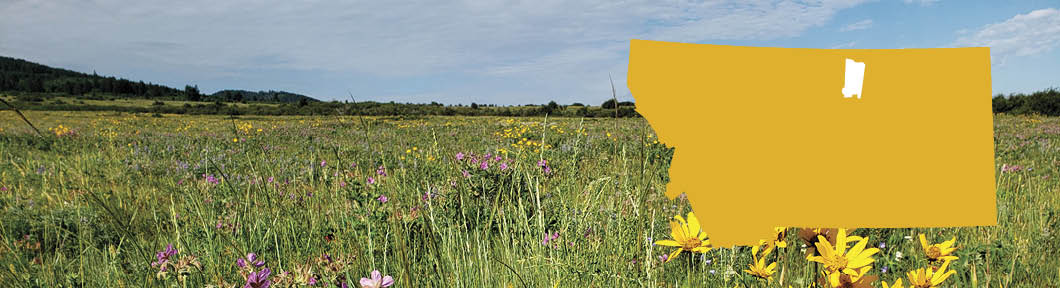
The Fort Belknap Indian Reservation is home to the Aaniiih and the Nakoda Tribes. Fort Belknap Indian Reservation encompasses 675,147 acres, including the communities of Fort Belknap Agency, Hays, Lodge Pole, and Dodson. Fort Belknap has a tribal membership of 7,000 enrolled members. The main industry is agriculture, consisting of small cattle ranches, raising alfalfa hay for feed, and larger dryland farms.
Each year, our priorities reflect the dynamic nature of the community’s needs. In 2025, efforts were directed at drought management strategies, the development of home-based food forests, and new directions in nutrition education. Additionally, faculty and staff provided leadership and resources to implement programs such as the 2025 Fort Belknap 4-H Fair, school-based nutrition education, and expanded collaborations with new partnerships.
Within the framework of MSU Extension’s directives, we are working to bring trusted resources to families, businesses, ranchers, and communities, as we have seen the power of education, diversity and community. Our outreach and program efforts have largely developed into a hybridized model of virtual, in-person and one-on-one approaches.
Contact
656 Agency Main Street
Harlem, MT 59526
406-353-2656
https://www.montana.edu/extension/fortbelknap/
4-H & Youth Development
4-H & Youth Development
The Lucky Charms 4-H Club currently has the largest membership with 29 members. This year, 19 youth showed and sold animal projects: 10 steers and 9 swine. Four other members gave interviews for woodworking, sewing, and gardening projects. The club had a very successful 2025 fair and livestock sale, bringing in more than $126,079 to the Fort Belknap community through animal sales and 4-H sponsorships.
The members of the Lucky Charms Club continued to learn important 4-H and life skills. The top priority of 4-H programs at Fort Belknap is the health and safety of our youth, families, volunteers, and supporters throughout our communities.
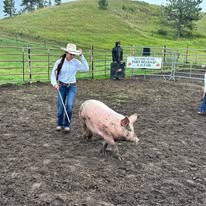
Caption: 4H fair in Lodgepole.
Credit: McKenzie McCaleb
Agriculture & Natural Resources
Agriculture and Natural Resources
One-on-one consultations and virtual workshops occurred throughout the year, consisting of drought response and resources, and application training and support for agriculture loans and assistance. Fort Belknap MSU Extension assisted youth producers and new producers with the Montana Department of Agriculture Rural Assistance Loans and Junior Agricultural Loans. Producers who continued to seek additional information were provided with unbiased information that aided in a solution.
Agent McKenzie McCaleb hosted two agricultural producer events this year: Rancher’s Roundup in February brought resources from FSA and the Fort Belknap Land Department to speak with producers from the Fort Belknap Reservation. The Rangeland Producer Field Tour and Expo in July brought local resources to Fort Belknap, including the Rancher’s Stewardship Alliance, The Nature Conservancy and USDA NRCS. The group learned from NRCS how to manage and monitor rangeland health and producers learned information on bookkeeping, ranch finance, and conservation.
Several gardening classes were held throughout the year, from how to start seeds all the way to seed saving. The goal for our office’s horticultural workshops are to become more food sovereign and heighten Fort Belknap community member’s access to fresh and local foods.
Community Vitality
Community Vitality
Tribal Leadership: This training model is unique in that it is being developed to implement in tribal communities with the flexibility of engaging neighboring non-tribal communities. Agent Liz Werk sees this project also as supporting a long-term potential model of cross-cultural leadership that may bridge the gap between previously unengaged/disconnected communities. As is often the case, a successful foundation leads to the next step in the development of this leadership model. Results from the adult and youth forums will be integrated into the tribal leadership training model.
Food Sovereignty: Food sovereignty is the right of people to healthy and culturally appropriate food produced through ecologically sound and sustainable methods, and their right to define their own food and agriculture systems. The coalition meets monthly at locations throughout the reservation, with the goal of improving utilization of resources to improve the local health of all tribal members. Additionally, educational workshops are provided through the year to support community initiatives in growing and preserving food as well as seed saving. An emerging partnership with the Aaniiih Nakoda College Library has provided our program with a safe and well-organized location for our seed bank.
Extension agents partnered with Blaine County MSU Extension to participate in the Community Heart and Soul project, with a focus on the community of Harlem. Community members attended four sessions and are continuing efforts in determining their next steps toward revitalization efforts. The return of the Harlem Christmas Stroll was a major victory by the members in bringing back a beloved community event. Agent Hillary Maxwell has been selected to fill the role of rural ambassador with the Montana Nonprofit Association. Duties include identifying nonprofits in the community, linking needs to resources and facilitating education and training to rural partners
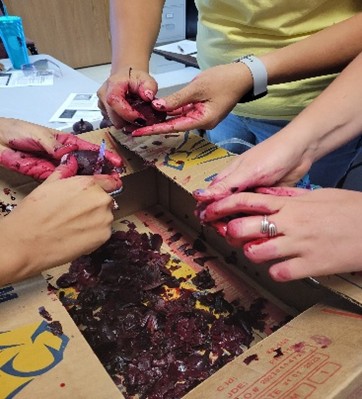
Caption: Preserving beets.
Credit: Hillary Maxwell
Montana State University Extension is an ADA/EO/AA Veteran’s Preference Employer and provider of educational outreach.