

Roosevelt County
2025 MSU Extension Highlights
2025 MSU Extension Highlights
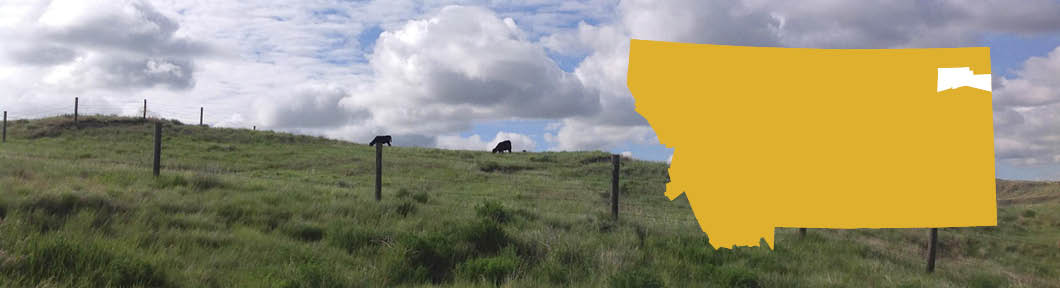
Roosevelt County, the 20th largest county in Montana, is located between the Missouri River and Sheridan County, and between the North Dakota state line and Daniels County. It includes 2,385 square miles, with farmland encompassing 86% of the land in Roosevelt County. Wolf Point is the county seat, and other incorporated cities include Bainville, Culbertson, Froid, and Poplar, where the Fort Peck Assiniboine and Sioux Tribal headquarters and the Fort Peck Community College are located. Other communities include Brockton and Fort Kipp.
Montana State University Extension is an educational resource dedicated to improving the quality of people’s lives by providing research-based knowledge to strengthen the social, economic, and environmental well-being of families, communities, and agricultural enterprises. The Roosevelt County MSU Extension staff provides services in the following areas: 4-H youth development, agriculture and horticulture, family and consumer sciences, and community and economic development.
Contact
307 Broadway Ave.
Culbertson, MT 59218
406-787-5312
https://www.montana.edu/extension/roosevelt
4-H & Youth Development
4-H Stir-ups Cooking Contest Comes to Roosevelt County
The 4-H stir-ups cooking contest was newly offered in Roosevelt County. The purpose of the contest is to prepare an appealing, nutritious meal that can be easily prepared with common ingredients available in many homes. Meals should be prepared using food safety techniques and reflect creative use of ingredients. The presentation of the meal should exhibit knowledge of the foods prepared, excellent public speaking and use of visual aid skills.
In its inaugural year, eight participants competed to make pizza. They were given a list of provided ingredients, but could only choose five from the list. They could also bring a “mystery” ingredient for their chosen recipe. They had 60 minutes to prepare a pizza and present it to the judge. Roubie Younkin from Valley County MSU Extension talked about the project and how to properly follow the guidelines.
With a variety of recipes, no two pizzas were the same. 4-H youth aged 6-13 years old took part in this event and didn’t have to be traditionally enrolled in cooking or baking projects. Participants learned new techniques like using knife skills, creating and following a recipe, understanding what ingredients work together, overall presentation of their product, and verbal skills in a fun and sharing environment. Students are already looking forward to competing next year and looking for ways to fit the competition into a 60-minute interval.
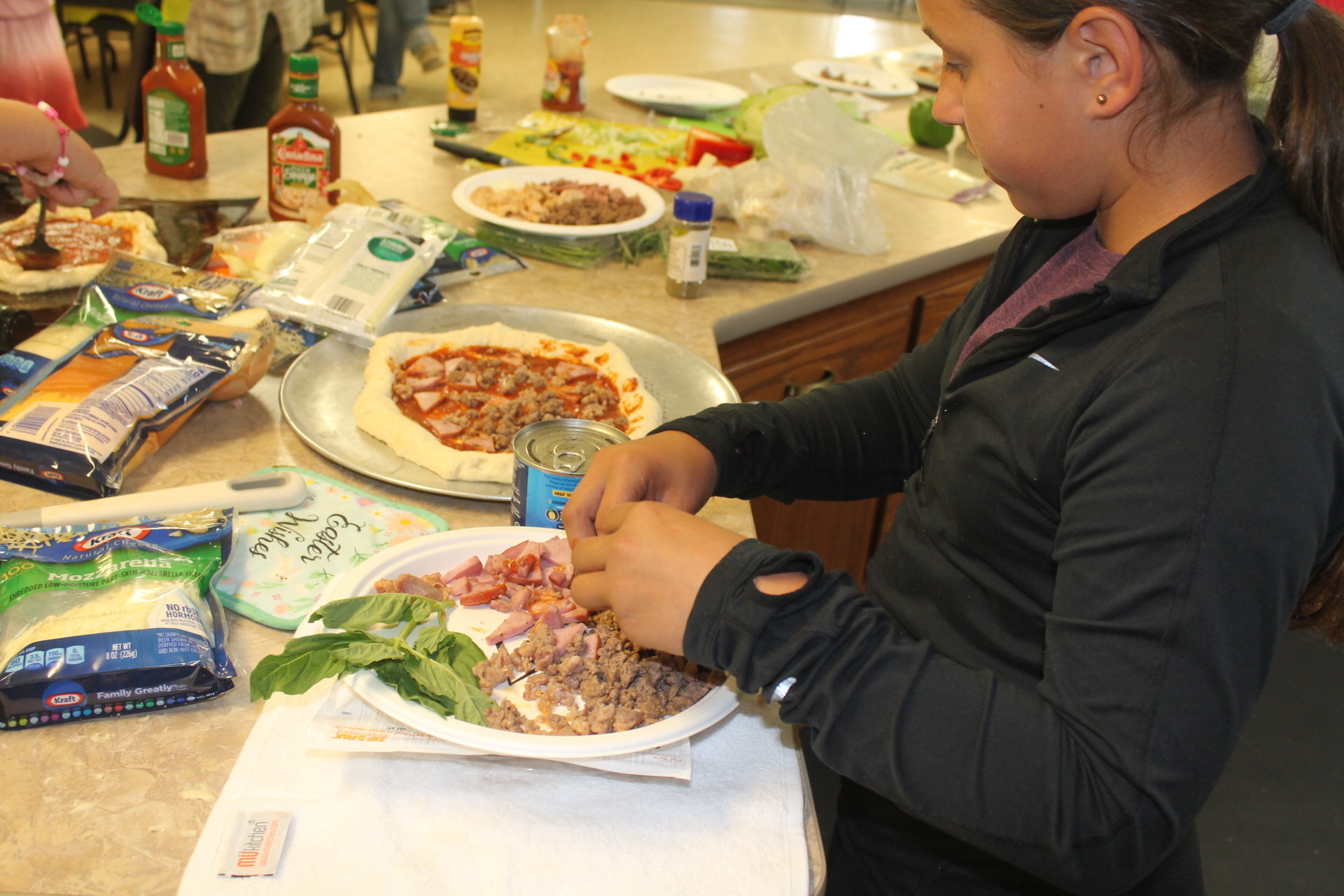
Caption: 4-H member prepares ingredients for her cooking contest pizza.
Credit: Wendy Becker
Agriculture & Natural Resources
Honey Extraction Time
National Honey Month is celebrated in September to promote beekeeping and honey. In late August/early September, beekeepers begin to collect the fruits of their seasonal labor. This is the best harvest time as honey flows better when it’s warmer and has less crystalizing capability. Commercial beekeepers begin collecting hives to extract honey and move them to the next pollination site, and hobbyist beekeepers also start honey harvest, maintain fall numbers, and start the process of winterization.
Many people don’t get the opportunity to see the process of honey harvesting. The Froid Research Farm Station has a beehive for education purposes. This is a cooperation between the soil conservation districts of Sheridan and Roosevelt Counties and MSU Extension. In fall, honey frames were collected from the hives and used for area agriculture classes to experience honey extraction.
Students from Culbertson, Bainville, and Froid agriculture and plant science classes learned how bees make honey, the importance to our area, and what we can do with the honey. But first, they had to extract it by taking frames full of honey from the hive and setting them up to uncap the honey. This can be done using a heated uncapping knife, and uncapping tub, and a cappings scratcher to free the wax-capped honey. This prepares frames for the extractor, which spins frames in a centrifugal action to pull honey from the frames. The honey is then put through a series of sieves or strainers to purify honey from wax or other foreign material. Then the students bottled the honey and shared it with their families or school personnel. Students used a refractometer to check the moisture and Brix, or sugar content, of the honey that was produced in this area.
Since bees and pollinators are so important to agriculture, it becomes vital to keep bees and honey production in agriculture conversations. Montana consistently ranks in the top 5 for honey production in the US. Bees are considered livestock because they produce a managed food product that enters the human food chain. The USDA estimates that three-fourths of the world’s flowering plants and 35% of the world’s food crops depend on pollination from animals such as bees, which can be estimated to represent one out of every three bites of food a person eats, making bees essential for life.
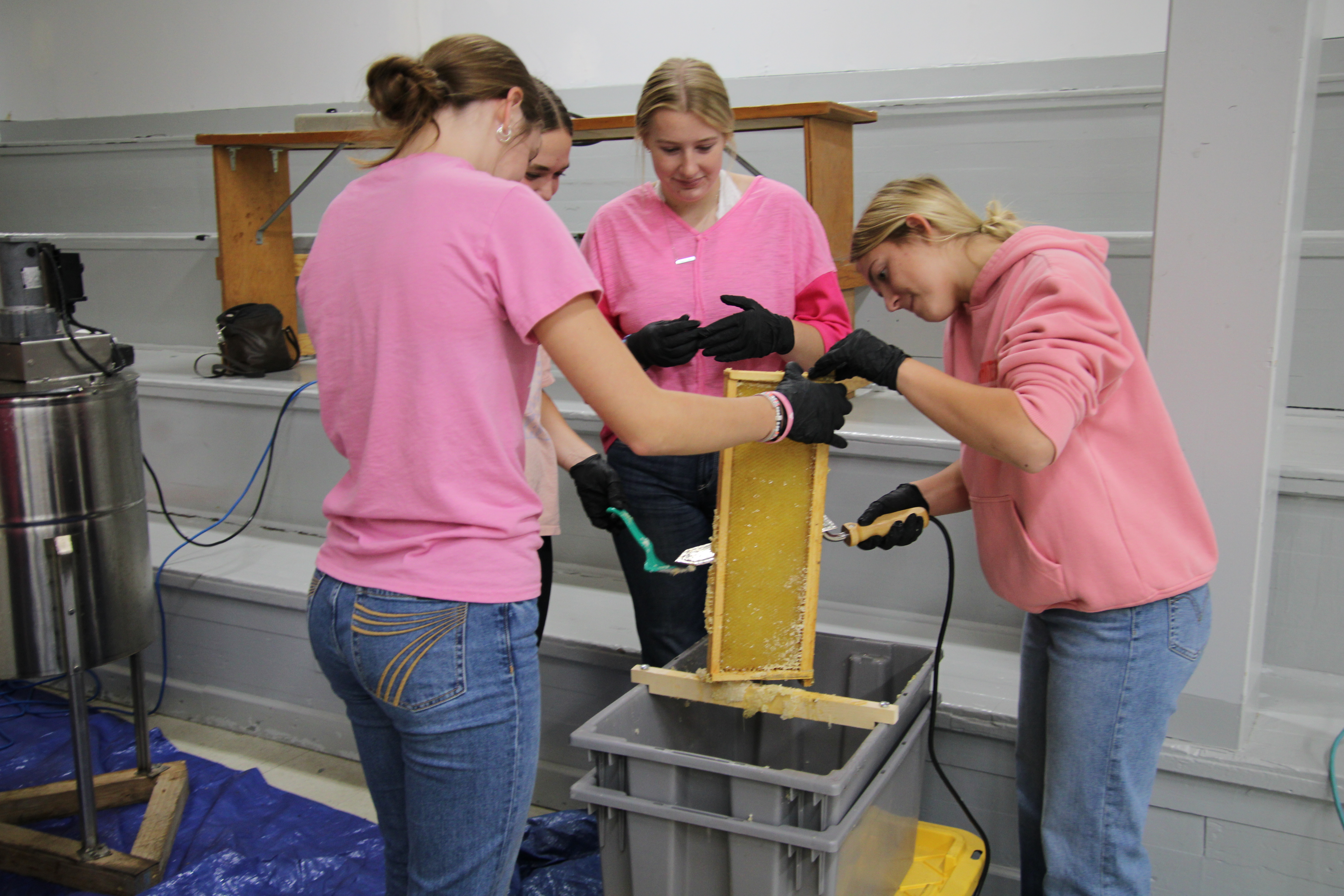
Caption: Students practicing the honey extraction process
Credit: Wendy Becker
Agriculture & Natural Resources
Roosevelt County Alfalfa Variety Plot
Alfalfa is consistently one of Montana's top economic crops, according to the National Agriculture Statistics Service. Alfalfa is usually grown on average, every five years. Technology changes drastically during that time. Not much research has been done in the last 30 years on alfalfa breeding for Foundation seed, but private industry has done research on Conventional and Roundup Ready varieties.
A research trial was conducted at the Froid Research Center to compare Foundation, Convention, and Roundup Ready seed varieties that are available to producers in Northeast Montana. Alfalfa seed was obtained using seven different varieties and planted in a prepared research plot. Data collection began in year two for first cutting and after-freeze second cutting on what is considered a dryland plot. Data was collected and shared from the first year results at the Froid Research Center Field Days, the Swank Family Farm Tour, and the technician used it as a research project for the agri-science competition through FFA.
The importance of this trial was to highlight the research as it compares to MSU Foundation Seed Program information. Since alfalfa isn’t grown every year like other cereal crops or annual crops, information about best growing conditions by region is harder to compare. Some producers aren’t comfortable growing Roundup Ready varieties, but are concerned that is the only seed available. All seeds were provided by local businesses that were also interested in the findings. Year two research information is being analyzed for the next research report.
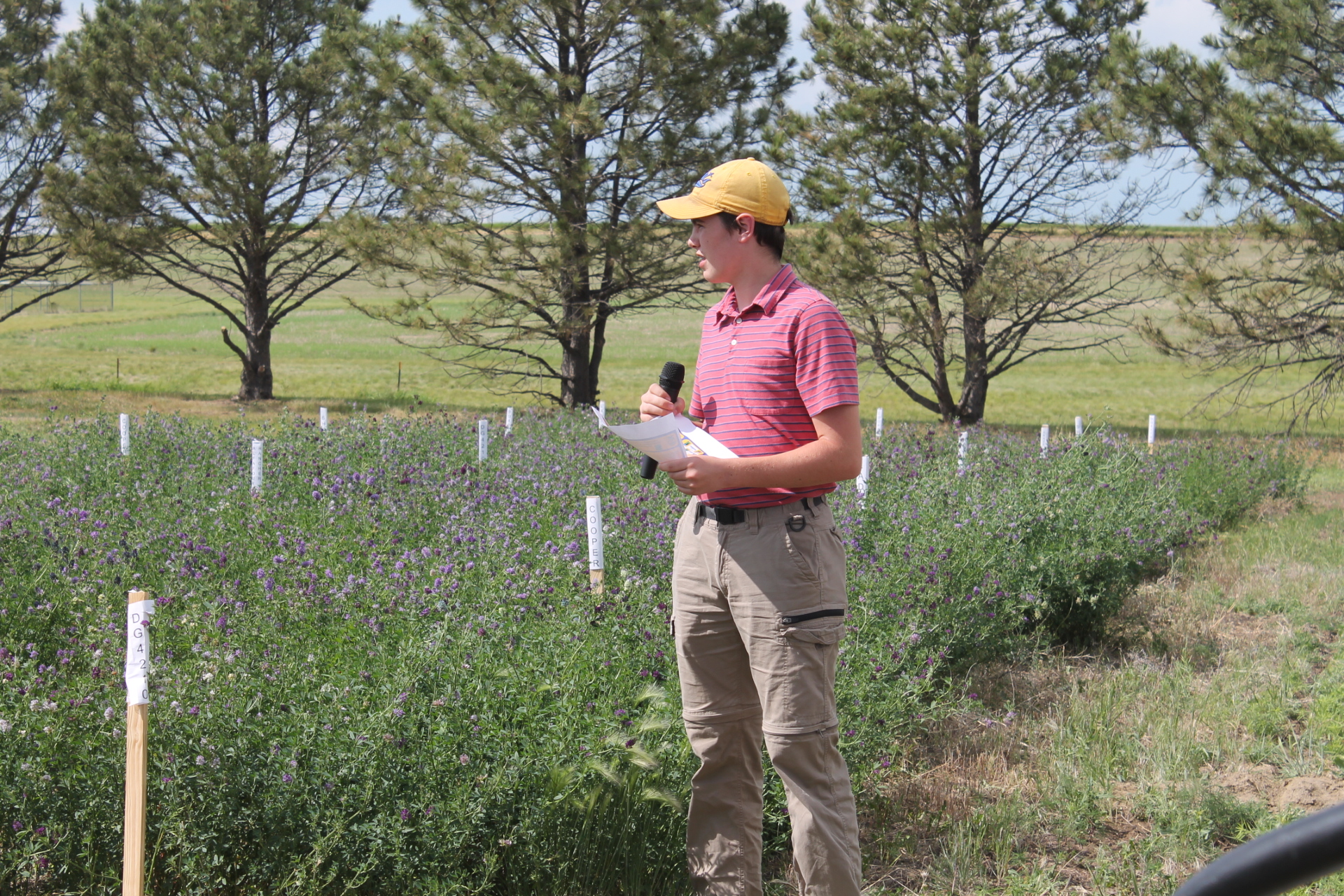
Caption: Felixe Becker presenting results for the Agriscience Competition project.
Credit: Wendy Becker
Montana State University Extension is an ADA/EO/AA Veteran’s Preference Employer and provider of educational outreach.