

Valley County
2025 MSU Extension Highlights
2025 MSU Extension Highlights
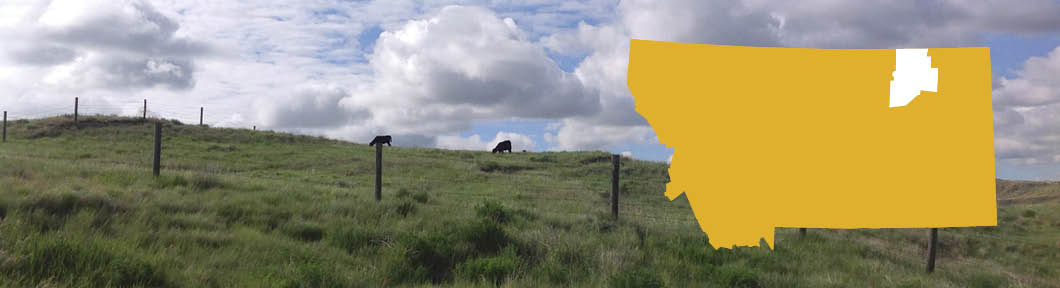
Providing research-based information, resources, and education in the areas of Family and Consumer Science, Youth Development, Agriculture, Natural Resources and Community Development have been the foundation of Valley County MSU Extension since 1917.
Valley County was established on February 6, 1893, having been carved out of the larger Dawson County territory. Valley county’s southern border, the Missouri river, was the hub of travel in the mid-1800s, bringing thousands of miners to the rich gold fields of Western Montana. Riverboat travel was replaced by rail traffic in the late 1880s and Siding 45 became Glasgow, Montana, when a rail clerk spun a globe and his finger landed on Glasgow Scotland. During the depression, Fort Peck Dam – the largest earth filled dam at the time, was built as part of President Franklin Delano Roosevelt’s New Deal Program.
Today, Valley County is rich in agriculture, supporting 42,460 beef cattle, over 68,000 acres of hay and haylage, and producing a wide variety of crops: wheat, durum, canola, dry peas, lentils, chickpeas (garbanzo beans) mustard, corn, safflower, and flax on its 1.63 million acres of agricultural land. Fishing and tourism are also important to Valley County, which hosts numerous fishing derbies, including the Governor’s Cup Walleye tournament and the Catfish Classic.
Contact
501 COURT SQ STE 12
Glasgow, MT 59230
406-228-6241
https://www.montana.edu/extension/valley
4-H & Youth Development
Positive Youth Development
Positive Youth Development is a research-based approach that 4-H uses to help young people thrive by building on their strengths, interests, and assets. The theory is that all youth have the potential for bright futures and can reach their full potential through intentional programs that provide opportunities, positive relationships, and support to develop skills like critical thinking, leadership, and civic engagement.
It isn’t just 4-H members who are building skills to last a lifetime. In Valley County, youth are moving forward toward their future through learning experiences that stress that they are safe, nurtured, challenged, active, healthy, recognized, respected and responsible. This is accomplished in the classroom and through homeschool activities as well as traditional 4-H clubs and programs.
Learning activities include 4-H Camp, traditional 4-H club meetings and projects, a nature-themed homeschool session, the science of embryology, erosion prevention using the Rolling River Trailer, robotics taught using Sphero robots, sewing, cooking, babysitting class and youth gardening.
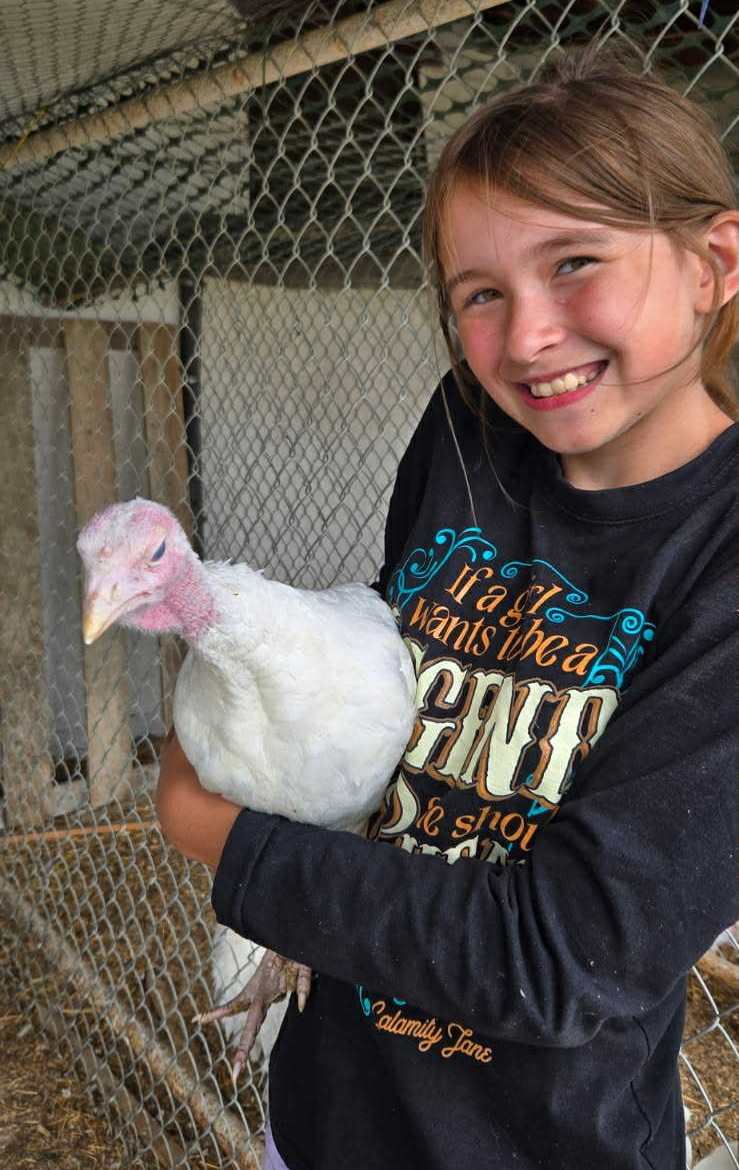
Caption: 4-H is about much more than just raising a turkey.
Credit: Roubie Younkin
Agriculture & Natural Resources
Waterhemp Confirmed in Valley County
No, it’s not good news. Waterhemp, a warm-season annual, has been confirmed to be growing on 800 acres of Valley County land and is suspected to have been there between three and five years.
Waterhemp is a member of the pigweed family and closely related to redroot pigweed and Palmer amaranth. The Weed Science Society of America ranks this weed seventh in troublesome weeds in crops, turf, and pasture. Each female plant can produce more than 250,000 to 1 million seeds, which are difficult to separate from crop seeds. Seed viability is around 80% and seeds can survive in the soil for over four years. It is a common contaminant of millet and can be spread by harvesting equipment and movement of hay. The plant is dioecious, meaning that there are separate male and female plants. Wind is the most common way that Waterhemp is pollinated and as a result, the plants can hybridize with several other species of pigweed, resulting in improved genetic diversity of the population and making it more difficult to identify. Unfortunately, this also creates the perfect breeding ground for developing herbicide resistance. Some populations have been shown to have resistance to over six different herbicide modes of action.
Tim Seipel, MSU Cropland Weed Scientist, is testing seed from the Valley County plants in his laboratory to determine what herbicides this population is resistant to. Once that information is gathered, we will develop a management plan for responding to, and hopefully eradicating, the infestation. Waterhemp can cause bloat in cattle or result in nitrate poisoning, which can sicken or kill livestock depending on severity.
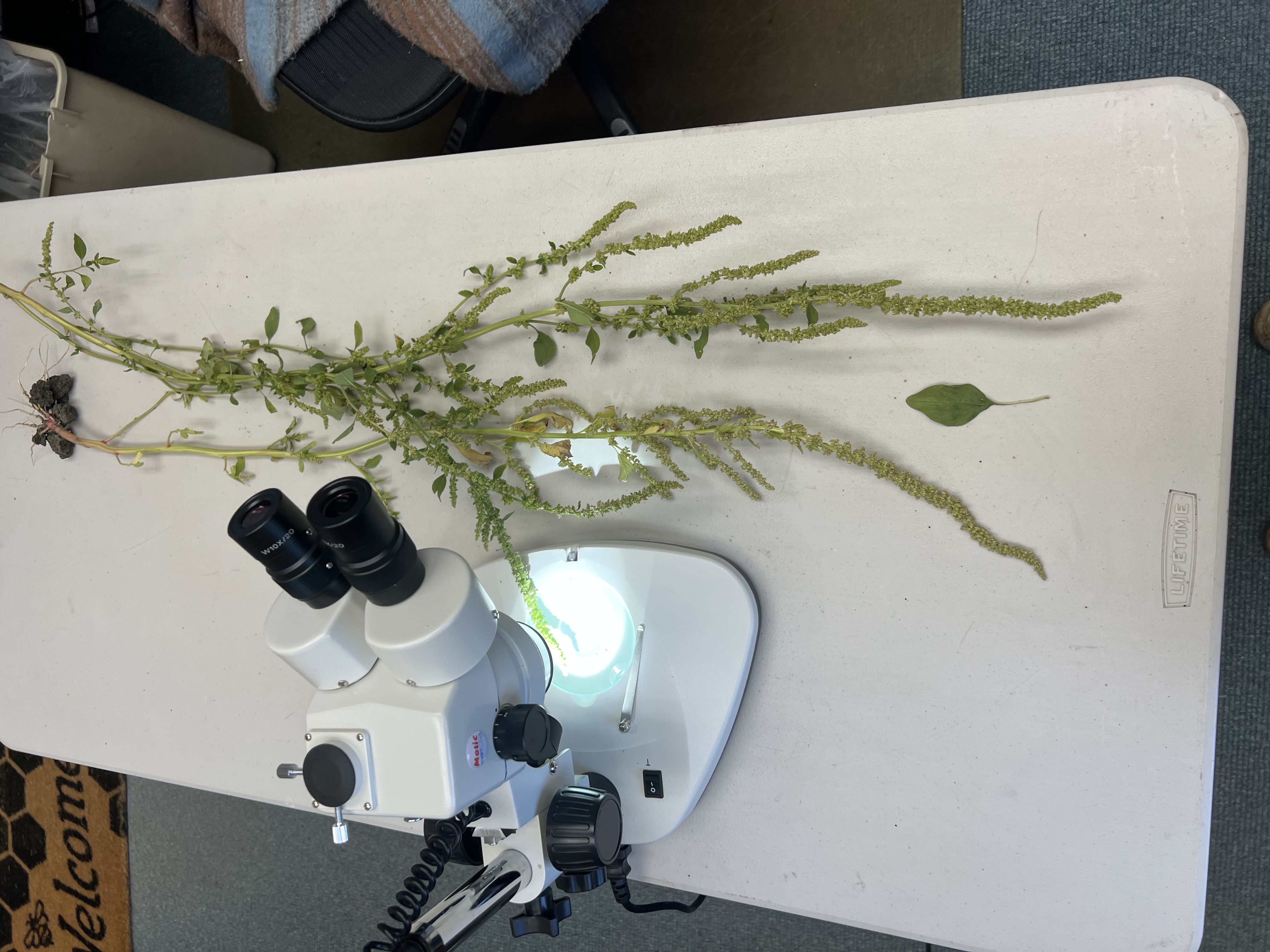
Caption: Waterhemp plants found in fields in Valley County
Credit: Shelley Mills
4-H & Youth Development
Teacher Workshop
Good teachers become great teachers when they go beyond the textbook to create an experiential learning environment for students. Because continuing education is an ongoing requirement of our Montana educators, Valley County MSU Extension Agents Shelley Mills and Roubie Younkin provide teacher training each year for local teachers.
This year’s program focused on inquiry-based classrooms and learning through research, application and critical thinking. Using the Riding the Trail theme, this two-day program encouraged teachers to use critical thinking skills to work their way through the challenges of teaching. Legends, Lawmen and Lore set the background for lessons in time management, the effect electronics have on a developing brain and AI in the classroom, with history and hints of art and ecology mixed in.
Legends, Lawmen and Lore featured outside speakers with expertise in screentime and utilizing Artificial Intelligence with intention in the classroom. The science of sourdough and its role in Montana history provided some fun hands-on learning, as did making balms from beeswax and lunch cooked in a Dutch oven.
A miniature western village created a challenge for Sphero robots as they were programmed to meet criteria in a quest to find outlaws. The Wild West Escape room introduced team building and critical thinking in a fun activity that could be replicated in the classroom.
Educators choose between 16 OPI renewal units or the option for 1 undergraduate or graduate credit from MSU Northern. Ideas incorporated from this learning experience increase teacher effectiveness in the classroom and improve the student learning experience.
By providing teachers with additional skills, the workshop has potential to save the school district money in several ways. Educators are better positioned to use in-house resources, reducing the need for costly external programs or consultants to teach. Additionally, the local offering reduces travel costs to earn continuing education credits.

Caption: Old West meets Robot in a continuing education workshop in Valley County.
Credit: Roubie Younkin
Agriculture & Natural Resources
Rooted in Montana Webinar Series Debut
Horticulture education is a key component of Valley County MSU Extension programs. Recognizing the need to provide outreach and education in gardening and horticulture topics and to reach more people across Montana, Valley and Daniels County collaborated to host “Rooted in Montana: a Virtual Coffee Hour for Gardeners,” consisting of 11 webinars during the winter of 2024-2025 on horticultural topics.
Each webinar was an hour long and featured a guest speaker presenting information in an area of expertise. Topics included seed selection, starting seeds, home greenhouses, vertebrate pests, soils and soil fertility, garden design and layout, Xeriscaping, tree maintenance, and common weeds, insects and diseases. Over 170 people registered for the Webex webinars and those who couldn’t view in person were sent a link to a recording of the webinar.
The information gathered through a Qualtrics survey at the end of each session is helping shape future topics for the series and provided valuable feedback to speakers. The series was such a success that it will continue in 2026, with the best times and topics for the new season to be determined.
We also collaborated to present a workshop in each county about forcing bulbs and another on seed starting and soil blocking. Gardening trays, soils, bulbs and materials for the workshops were purchased with funds from a Western SARE grant. Home Depot in Billings supported the event by providing a large discount on the pots used in the Forcing Bulbs workshops.
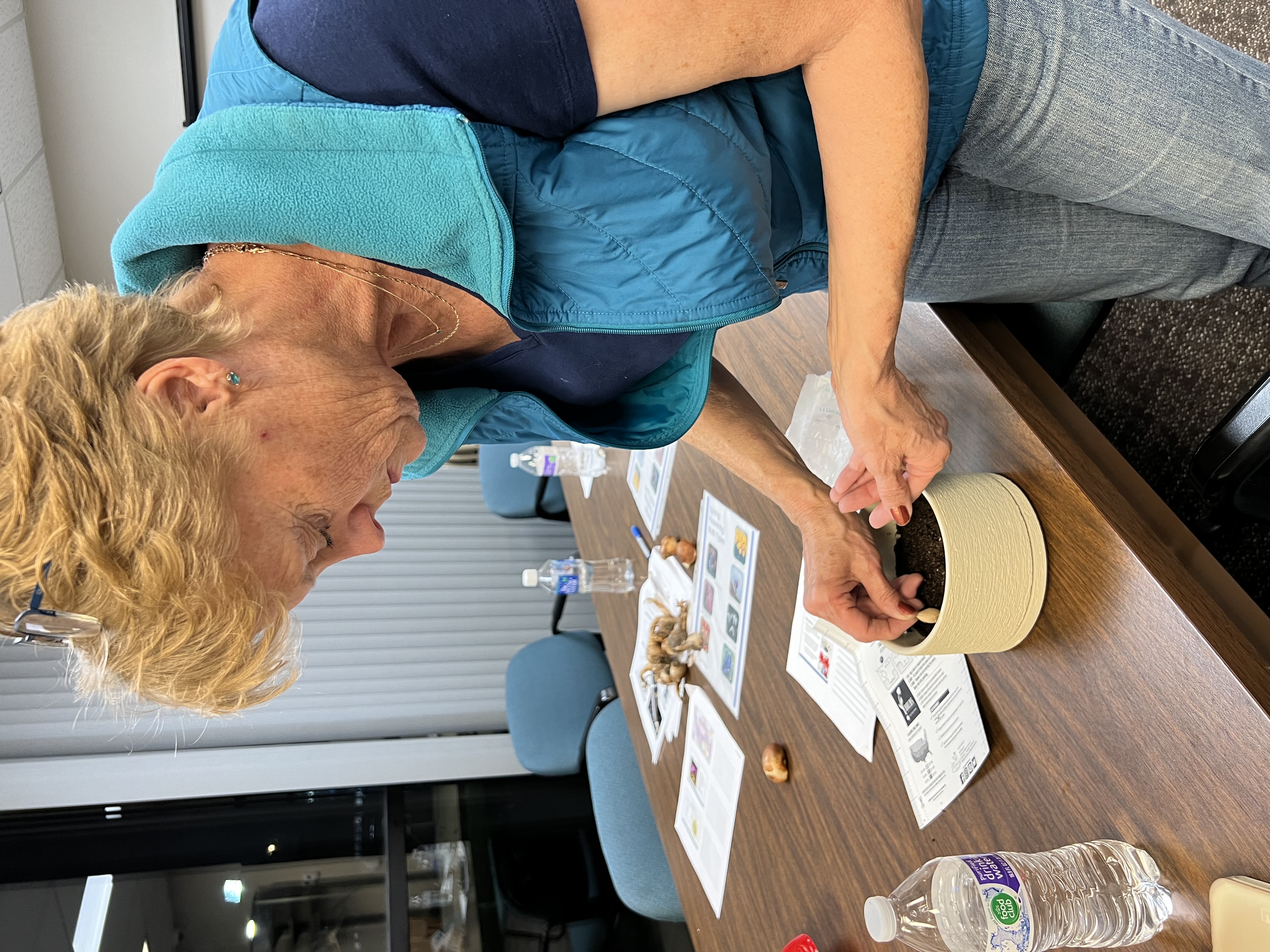
Caption: Robyn Cassel plants crocus bulbs in a pot as part of the forcing bulbs workshop.
Credit: Shelley Mills
Family & Consumer Science
Family and Consumer Science
Every aspect of healthy living is incorporated into FCS programming. Impacts are measured in food safety, food preservation, nutrition, chronic disease, building strength, financial awareness and estate planning and mental health, which all fit under this umbrella. When community concerns arise, expertise and resources are combined to deliver impactful solutions.
ServSafe food safety training ensures that food managers and handlers know safe practices.
This program is offered to adults and teens in the high school Culinary Arts and La
Cuisine classes, where participants earn certificates representing their knowledge.
Some classes offered are both scientific and fun. In-person and virtual "Solving the
Mystery of Sourdough" covers microbial growth of sourdough, as well as the challenge
of dough inclusions and how to achieve the self-expression seen in artistic bread
designs.
Strong People Strength Training offers regularly scheduled exercise opportunities where participants achieve improvement in strength and balance.
Family and Consumer Science programs empower families and individuals with skills, knowledge and confidence to improve their well-being, which in turn leads to strong communities. These programs combine research-based information to address needs in the community and teach lessons that contribute to health, economic stability and community vitality.

Caption: Sourdough bread made in a Family and Consumer Sciences class.
Credit: Roubie Younkin
Agriculture & Natural Resources
Volunteers Become Citizen Scientists
There is increasing concern for pollinator preservation and especially for native pollinators. With recent guest appearances from MSU researchers Abi Saeed, Casey Delphia, and Michelle Flenniken on Montana Ag Live, requests from Valley County residents to learn more about helping native bees and supporting pollinators have been pouring in.
In July of 2025, Valley County MSU Extension collaborated with Patricia Gilbert-Ball and Sue Dalbey of the US Army Corps of Engineers (USACE) and Abi Saeed, MSU Extension Horticulture Specialist, to provide a two-day workshop on pollinators and learning to be citizen scientists. Classes included instruction in pollinator identification, plant and pollinator interactions, and trapping & preserving insects, and in the 23-acre pollinator plot participants tested their ability to identify pollinator plants, learned how to collect insects, and discovered how to preserve the insects they caught for identification at MSU.
On the second day participants learned about tree care, pruning and urban forestry management. While conducting a tree walk, the participants put their new skills to work to learn about and identify ground nesting insects and their role in the ecosystem. Nine participants completed both days of classroom and hands-on training. They intend to collect more specimens from the area to send to Abi Saeed for identification, plant pollinator plants in their gardens using what they learned in the workshop, and vowed to attend again for more education in 2026.
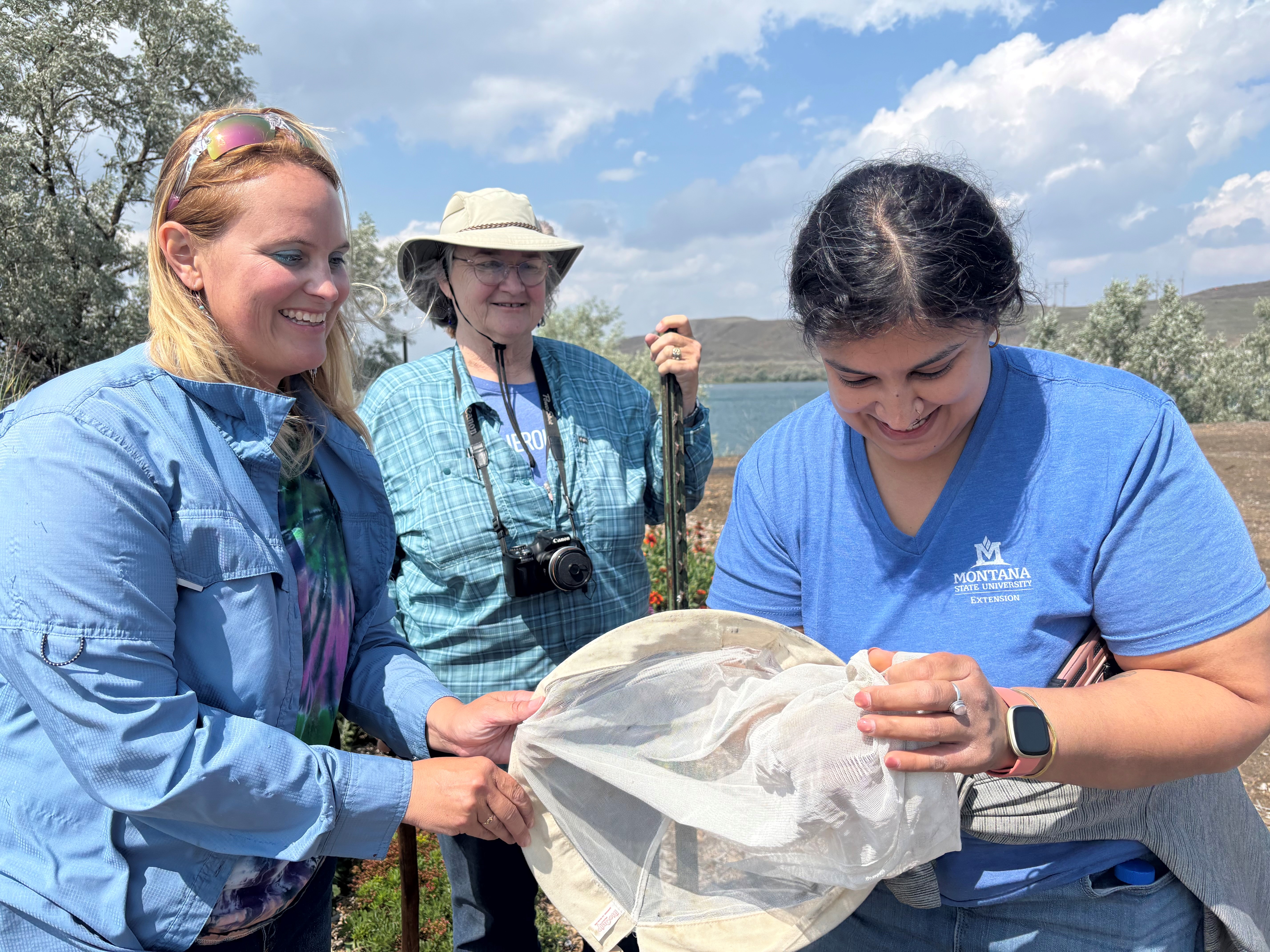
Caption: Abi Saeed (right) demonstrates proper insect collection techniques to Katie Busch (left) and Linda Sibley (middle).
Credit: Patricia Gilbert-Ball, USACE
Montana State University Extension is an ADA/EO/AA Veteran’s Preference Employer and provider of educational outreach.