

Bad Words and Dementia
Reading Guide
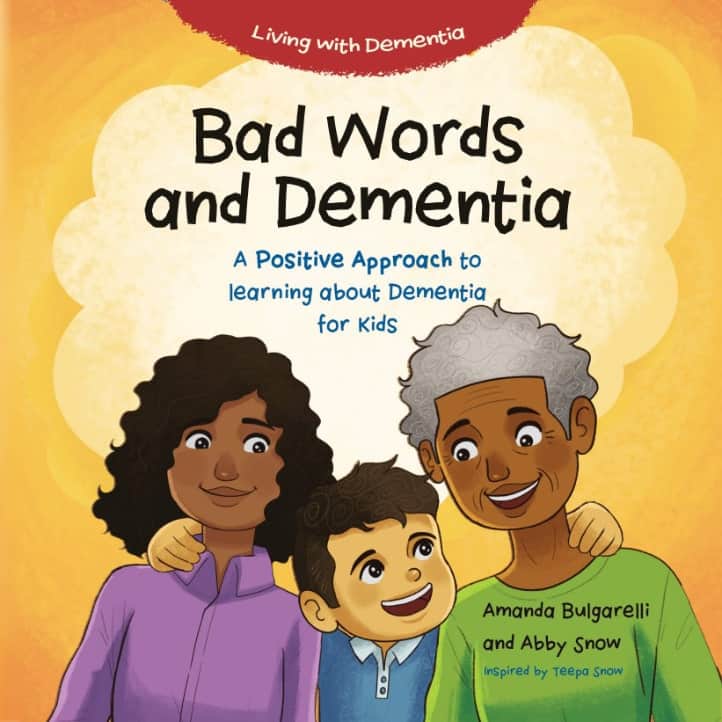
By: Amanda Bulgarelli and Abby Snow
Inspired by: Teepa Snow
About this Program
The MSU Extension Alzheimer's Dementia Awareness for ChildrenStorybook program is designed to teach children about a form of dementia.
The goals of the program are:
1) increase awareness and knowledge about Alzheimer’s (a form of dementia) and
2) provide supportive resources to children and families when they have a loved one
diagnosed with Alzheimer's.
The authors of this reading guide are:
- Ocean Jones, Montana State University Hilleman Scholar
- Marsha A. Goetting, MSU Extension Family Economics Specialist
Brief Summary
Every Saturday a young boy visits his grandma who lives in a special home. The boy
brings his grandma things she can fix, like a broken doll chair. He knows she likes
to fix things. When his grandma was fixing the doll chair, she let a bad word slip–
“Sh*t!.” When The boy’s mom came to see how the boy and his grandma were doing, the
boy asked his mom if she could help them fix the “sh*t chair.” His Mom looks extremely
uncomfortable. She says that they should call the
chair “naughty” instead. They work together and fix the chair. On the car ride home,
the boy's mom tells him that “sh*t” is a bad word that can get kids in trouble. She
explains to him that people with dementia sometimes cannot remember the appropriate
words to use. She says that it is important for him to say other words so that Grandma
does not say inappropriate words.
Questions to Ask
- What do you think made Grandma upset?
- Why was the boy's mom upset?
- Why should kids not use the “sh*t” word?
- What did Mom tell the boy to do next time Grandma uses a word that is only for grown-ups?
Activity Enrichment
- If the child is saying inappropriate words, have them create a list of words that
are similar. For example, if the child is saying the “sh*t” word, the list would include
words like “poop,” “bad,” “crap” and “sucky.”
- Ask if the child has heard other, in addition to Grandma who has said bad words. What should the child do next time they hear the naughty word?
Common Reactions
- Funny: A child could think the words their loved one with Alzheimer's say are funny and repeat them.
- Confused: A child could feel confused when they are not allowed to say words their loved one with Alzheimer's says.
- Frustrated: A child could feel frustrated when they are told they cannot say words that their
loved one with Alzheimer's says.
Other Reading Guides and One Free Alzheimer's Storybook Order Form
Other Storybooks and Reading Guides can be found at: https://www.montana.edu/extension/alzheimers/booksandreadingguides.html
An order form is available at this website to request onefreecopy of an Alzheimer’s storybook (while supplies last).This order form is intended for only Montana residents.
Funding for purchase of the storybooks in this program have been made possible by
a grant from the Montana Geriatric Education Center at the University of Montana,
AARP Montana, and by the Endowment fund from National Extension Association of Family
& Consumer Sciences (NEAFCS).