


Gardening with Grandma
Reading Guide
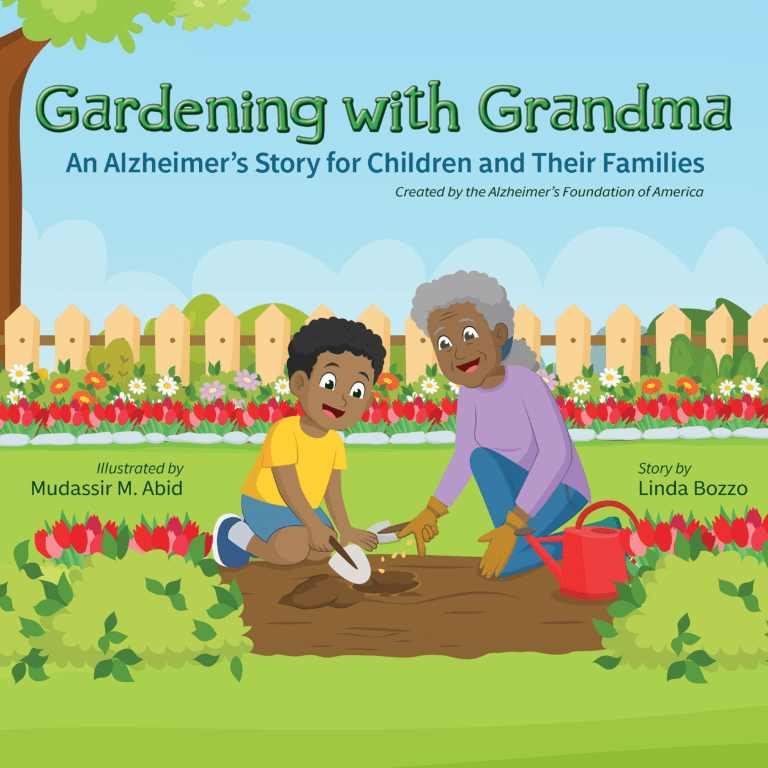
By: Linda Bozzo
Illustrated by: Mudassir M. Abid
About this Program
The MSU Extension Alzheimer's Dementia Awareness for ChildrenStorybook program is designed to teach children about a form of dementia.
The goals of the program are:
1) increase awareness and knowledge about Alzheimer’s (a form of dementia) and
2) provide supportive resources to children and families when they have a loved one
diagnosed with Alzheimer's.
The authors of this reading guide are:
- Ocean Jones, Montana State University Hilleman Scholar
- Marsha A. Goetting, MSU Extension Family Economics Specialist
Brief Summary
Luke loves to garden with his grandma. One spring, Luke’s grandma started forgetting things while she and Luke were gardening together. She tried to plant a packet of marigold seeds that she thought were tomato seeds. She forgot where she placed her watering can. Luke told his parents that he was worried about Grandma. His parents told him that his grandma has Alzheimer's. They said that spending time with Grandma and doing chores together will help her feel better. When Luke's Grandma's memory starts to decline, the doctors suggest she move to a home with adult caregivers to help her. This makes Luke feel sad. His grandma assures him that they can still garden together at her new home, and that is exactly what they did.
Questions to Ask
- Luke likes to garden with his grandma. What kinds of activities do you like to do with your loved one with Alzheimer's?
- When Luke sees all the dishes in his grandma's sink, what does he do?
- What does Luke's mom tell him when he asks if he will get Alzheimer's?
Activity Enrichment
- Buy a small plant. Ask the child to give the plant a memory, one they will share with
their loved one with Alzheimer's. Ask the child to watch the memory plant grow and
change. Encourage the child to honor the memory plant by watering and taking care
of it.
- Ask the child to draw a garden plot on a sheet of paper. Ask the child to draw different flowers and vegetables (carrots, beans, tomatoes) to put in their garden. Have an adult cut the garden flowers and veggies out and cut small slits in the garden plot drawing. Put the garden flowers and veggies in the slits and demonstrate the process of growing and harvesting (taken out of the plot) by moving the flowers and veggies up and taking them out. Explain to the child that memories for people with Alzheimer's can be similar, memories can pop up and they can also disappear.
Common Reactions
- Worried: Children could feel worried when their loved one with Alzheimer's Disease forgets things.
- Sad:Children could feel sad when their loved one with Alzheimer's moves to a memory care facility
- Scared: Children could feel scared because they think that they will get Alzheimer's.
- Guilty: Children could feel guilty when they correct their loved one with Alzheimer's.
Other Reading Guides and One Free Alzheimer's Storybook Order Form
Other Storybooks and Reading Guides can be found at: https://www.montana.edu/extension/alzheimers/booksandreadingguides.html
An order form is available at this website to request onefreecopy of an Alzheimer’s storybook (while supplies last).This order form is intended for only Montana residents.
Funding for purchase of the storybooks in this program have been made possible by
a grant from the Montana Geriatric Education Center at the University of Montana,
AARP Montana, and by the Endowment fund from National Extension Association of Family
& Consumer Sciences (NEAFCS).