


Gramp's Treasured Memories
Reading Guide
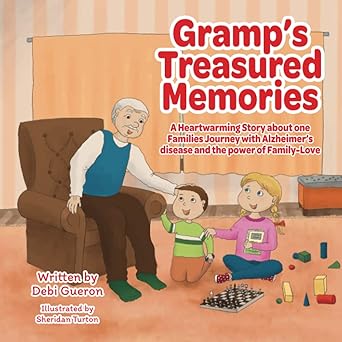
By: Debi Gueron
Illustrated by: Sheridan Turton
About this Program
The MSU Extension Alzheimer's Dementia Awareness for ChildrenStorybook program is designed to teach children about a form of dementia.
The goals of the program are:
1) increase awareness and knowledge about Alzheimer’s (a form of dementia) and
2) provide supportive resources to children and families when they have a loved one
diagnosed with Alzheimer's.
The authors of this reading guide are:
- Ocean Jones, Montana State University Hilleman Scholar
- Marsha A. Goetting, MSU Extension Family Economics Specialist
Brief Summary
Kyle and Shelly love to hear stories told by Gramps. He likes to tell them repeatedly– but Kyle and Shelly never get tired of them. Gramps has Alzheimer's disease. This means sometimes he forgets things, like Kyle’s name. Kyle and Shelly are worried that Gramps will forget them. Their dad explains that while Gramps forgetting them is a possibility, Gramps heart will always remember them. Kyle and Shelly make a list of all the fun things they can do with Gramps to cherish every moment with him, and that is exactly what they do, create experiences their hearts will never forget.
Questions to Ask
- What does Kyle and Shelly’s dad say Alzheimer's is?
- What did Gramps say is the best toy of all?
- When Gramps feels sad that he forgot Kyle's name, what does Gramps suggest they do?
- Why did Gramps look out the window near sundown?
- What worry do Kyle and Shelly have about Alzheimer's and Gramps?
- What did Kyle and Shelly do to cherish their moments with Gramps?
Activity Enrichment
- Make a list of fun things a child can do with their loved one with Alzheimer's disease. This can include listening to songs together, reading books together, or playing cards together.
- Find a small cardboard box. Ask the child to make a treasure chest. Write down stories and memories of their loved one with Alzheimer's Disease. The treasure chest is a fun way to store memories and stories.
Common Reactions
- Excited: A child could feel excited when their loved one with Alzheimer's disease moves in with them.
- Happy: A child could feel happy to hear and memorize their loved one’s stories.
- Sad: A child could feel sad when their loved forgets their name.
- Scared: A child could feel scared that their loved one might forget about them.
- Urgent: A child could feel like they need to rush to spend time and make memories with their loved one.
Other Reading Guides and One Free Alzheimer's Storybook Order Form
Other Storybooks and Reading Guides can be found at: https://www.montana.edu/extension/alzheimers/booksandreadingguides.html
An order form is available at this website to request onefreecopy of an Alzheimer’s storybook (while supplies last).This order form is intended for only Montana residents.
Funding for purchase of the storybooks in this program have been made possible by
a grant from the Montana Geriatric Education Center at the University of Montana,
AARP Montana, and by the Endowment fund from National Extension Association of Family
& Consumer Sciences (NEAFCS).