


Grandpa and Lucy
Reading Guide
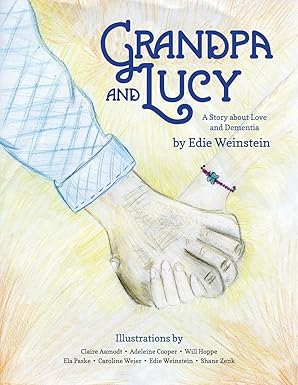
By: Edie Weinstein
Illustrated by: Claire Aamodt, Adeleine Cooper, Will Hoppe, Ela Paske, Caroline Weier, Edie Weinstein,
and Shane Zenk
About this Program
The MSU Extension Alzheimer's Dementia Awareness for ChildrenStorybook program is designed to teach children about a form of dementia.
The goals of the program are:
1) increase awareness and knowledge about Alzheimer’s (a form of dementia) and
2) provide supportive resources to children and families when they have a loved one
diagnosed with Alzheimer's.
The authors of this reading guide are:
- Ocean Jones, Montana State University Hilleman Scholar
- Marsha A. Goetting, MSU Extension Family Economics Specialist
Brief Summary
Lucy, her mother, and her grandpa go to the movies. When they get there, the theater is empty. Grandpa forgot the movie tickets! He also forgot what time the movie was supposed to start. When Lucy and Grandpa return home, Lucy finds the tickets. The movie tickets were for the day before. Grandpa gets embarrassed, yells at Lucy, and calls her Miranda. This made Lucy cry. Lucy's Mom explains to her that Grandpa has Alzheimer's disease. The disease makes him have a difficult time remembering things–and not act like himself. The next time Lucy goes to Grandpa's house, they look at pictures and listen to music together. This reminds Grandpa of good memories. They have a lovely time together before it is time for Lucy to go back home.
Questions to Ask
- What happened that made Lucy disappointed?
- What did Grandpa call Lucy that made her upset? Why did that upset her?
- What does Lucy’s Mom suggest Grandpa could have been feeling that made him yell at Lucy?
- What stories does Grandpa remember?
- Lucy’s Mom says that Grandpa’s memories are like a bookshelf.What books fall off the bookshelf first?
- What does Mom tell Lucy it is particularly important for her “not to do” when Grandpa calls her Miranda?
- What does Lucy bring to show Grandpa?
Activity Enrichment
- Have the child help you make a stack of books. Write on sticky notes the child's earliest memories, and their most recent memories (for example, what they ate for breakfast this morning). Put the earlier memories on the top books, and the old memories on the bottom books. Use this to explain what memories are easier for people with Alzheimer's to forget.
- Have the child draw different emotions (for example, sad, happy, angry, etc.). Ask them how they think both Lucy and Grandpa felt during various parts of the book.
Common Reactions
- Disappointed: A child could feel disappointed when their loved one with Alzheimer's messes up a plan they made together.
- Sad: A child could feel sad when their loved one with Alzheimer's forgets their name.
- Happy: A child could feel happy to help their loved one with Alzheimer's remember things and have an enjoyable time.
Other Reading Guides and One Free Alzheimer's Storybook Order Form
Other Storybooks and Reading Guides can be found at: https://www.montana.edu/extension/alzheimers/booksandreadingguides.html
An order form is available at this website to request onefreecopy of an Alzheimer’s storybook (while supplies last).This order form is intended for only Montana residents.
Funding for purchase of the storybooks in this program have been made possible by
a grant from the Montana Geriatric Education Center at the University of Montana,
AARP Montana, and by the Endowment fund from National Extension Association of Family
& Consumer Sciences (NEAFCS).