

Position Profile
Contents
- The Opportunity
- About the Position
- MSU by the Numbers
- A New Strategic Plan
- About the President
- About Bozeman and the Region
- Major Academic Achievements
- Strategic Opportunities for Leadership
- Required Qualities and Qualifications
- Key Skills and Leadership Attributes
- Nomination and Application Process
The Opportunity
Montana State University (MSU), Montana's premier land-grant university and Carnegie R1 research institution, invites applications and nominations for the position of Executive Vice President for Academic Affairs and Provost. The next Provost will join the university at a pivotal moment, partnering with President Brock Tessman and the campus community to advance academic excellence, strengthen student success, expand research and graduate education, and further the university's land-grant mission through teaching, scholarship, service, Extension, and community engagement.
As MSU's chief academic officer, the Provost will provide strategic and operational leadership across the academic enterprise, fostering excellence within, and integration across, teaching. The provost will guide academic departments and interdisciplinary programs, steward faculty, staff, and financial resources, and support the success of students across Montana and beyond. Working collaboratively with colleagues throughout the university and the statewide university system, the Provost will help translate the next university strategic plan into meaningful action while promoting a culture of trust, transparency, accountability, and shared purpose.
The Provost will serve as a trusted partner to President Brock Tessman in implementing an ambitious vision for Montana State University's future. The successful candidate will strengthen collaboration across academic, foster collegial relationships, support faculty and staff success, recruit and retain outstanding talent, and help serve a growing and increasingly accomplished student population. Exceptional communication, active listening, relationship building, and consensus building are essential, as is a demonstrated commitment to transparent leadership and meaningful shared governance.
The successful candidate will possess an earned terminal degree from an accredited university and a distinguished record of teaching, scholarship, and research that supports appointment as a tenured full professor at Montana State University. The successful candidate will also bring significant senior academic leadership experience; integrity; sound judgement; strategic vision; intellectual curiosity; and a demonstrated commitment to collaboration, academic excellence, faculty success, and the values of a land-grant, Carnegie R1 university.
As chief academic officer, the Provost leads the deans of the College of Agriculture; the College of Arts and Architecture; the Jake Jabs College of Business and Entrepreneurship; the College of Education, Health and Human Development; the Norm Asbjornson College of Engineering; the College of Letters and Science; the Mark and Robyn Jones College of Nursing; the Graduate School; Gallatin College MSU; the Honors College, and the MSU Library. Montana State University serves roughly 17,500 students through more than 250 undergraduate programs and 120 graduate programs and supports over $300 million in annual research expenditures. Montana's largest university and a proud land-grant institution combines world-class research, student-centered learning, and a deep commitment to serving the people and communities of Montana.
About the Position
The Executive Vice President for Academic Affairs and Provost is the second-ranking officer of the university. As chief academic officer, the Provost:
- Provides leadership oversight for academic and scholarly excellence, academic planning stewardship, and fiscal management for the academic enterprise.
- Approves academic appointments, makes recommendations to the President on promotion and tenure decisions, and is responsible for ensuring the excellence of faculty, academic programs, and student learning outcomes throughout the university.
- Manages a significant portion of the university's annual budget and provides direct and meaningful input to the President regarding current and future budget allocations.
These responsibilities are carried out in coordination with the policies and direction of the Montana Board of Regents and the Office of the Commissioner of Higher Education and within a culture that values transparency, collaboration, active listening, respect for shared governance, and broad campus engagement. The provost must work effectively with faculty, students, staff, administrators, unions, alumni, legislators, community partners, and other stakeholders in advancing the university's mission and strategic priorities.
Reporting to the position are the deans of 10 colleges and schools, the MSU Library, three vice provosts (including Graduate Education), and directors and centers, including the MSU Launchpad, Academic Outreach, Academic Technology, the Leadership Institute, the WWAMI Medical Education Program, Program and the Office of International Programs. Additionally, the Provost works closely with, and collaborates with, the Vice President for Research and Economic Development, as well as all other members of the MSU executive team. The Provost also plays a significant leadership role in advancing collaborations and strategic initiatives across the statewide, including MSU Billings, MSU Northern and Great Falls College MSU.
The Provost represents the university before state agencies, external organizations, the Office of the Commissioner of Higher Education, and the Board of Regents of the Montana University System. The position plays a central role in advancing statewide academic initiatives, supporting research growth, strengthening graduate education, and contributing to fundraising and external engagement efforts. The Provost will provide leadership in implementing the university's forthcoming strategic plan and ensuring its successful integration throughout the academic enterprise.
The next Provost will be a visible, accessible, and engaged leader who supports excellence across research, teaching, service, and community engagement. The successful candidate will demonstrate a commitment to transparent communication, meaningful engagement with faculty and staff, and collaborative leadership that builds trust across the institution. The Provost will bring the experience necessary to advance academic initiatives at institutional, statewide, and national levels, while supporting faculty recruitment, retention, professional growth, and long-term success.
The Provost will champion Montana State University's history and mission as a land-grant institution; support the intellectual, cultural, artistic, athletic, and civic dimensions of university life; promote an international perspective; and demonstrate a strong commitment to graduate education, research excellence, innovation and student achievement. The successful candidate will value the full breadth of MSU's academic portfolio - from two-year education to doctoral studies, from Extension activities to basic and applied research - and will appreciate the contributions of every discipline to the university's mission.
MSU by the Numbers
Fall 2026 Enrollment
- 14,477 Total Students
- 15,341 undergraduate
- 2.046 graduate
Student Body Profile
- 48% Female
- 51% Male
- 1% Not Identified
-
16% Underrepresented Race/Ethnicity\
-
50% Montana residents
-
50% Non-residents
-
17% First Generation
-
Students from all 50 U.S. states
-
International students from 69 countries
Academic Achievements
- Boren Scholars 15 students
- Fulbright Scholars 43
- Gates-Cambridge Scholars 2
- Goldwater Scholars 92
- Marshall Scholars 2
- National Academy of Medicine members 2 (1 active, 1 emeritus)
- National Academy of Sciences 2 (1 active, 1 emeritus)
- NSF CAREER Awards 44
- Rhodes Scholars 12 (two in the past 10 years)
- Schwarzman Scholars 5
- Truman Scholars 18
- Udall Scholars 21
Employees
- 622 Tenurable Faculty FTE
- 441 Non-tenurable Faculty FTE
- 2,086 Staff FTE
- 18:1 Student/Faculty Ratio
Colleges and Schools Reporting to the Provost
- College of Agriculture 1,988 students
- College of Arts & Architecture 1,055
- Jake Jabs College of Business & Entrepreneurship 2,628
- College of Education, Health & Human Development 1,905
- Norm Asbjornson College of Engineering 3,397
- College of Letters & Science 3,204
- University College 544
- Gallatin College MSU 1,126
- Honors College 1,887
- MSU Library Mark & Robyn Jones College of Nursing 1,442
A New Strategic Plan
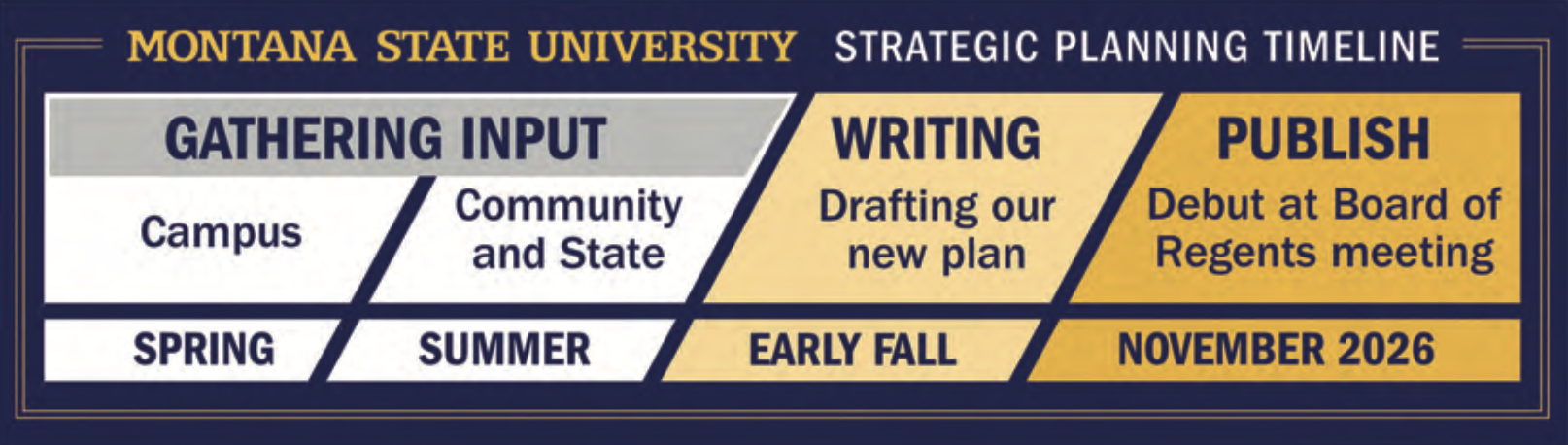
MSU's next strategic plan is being built through sustained engagement across the university and the communities it serves. The process began in February 2026, when a planning team began gathering perspectives from campus, the surrounding Gallatin Valley, and stakeholders across Montana. The process resulted in more than 4,000 individual points of contact with stakeholders and university community members, spread across online surveys, in-person listening sessions and individual meetings.
The input resulted in a menu of projects that will serve as the heart of the new strategic plan. Those projects will shape the actions that MSU will take as it moves into its next bold chapter. October will bring the final drafting and preparations for the new strategic plan, which will be rolled out November 19 at the Montana Board of Regents meeting, to be hosted at MSU.
About the President

Brock Tessman
Dr. Brock Tessman is the 13th president of Montana State University. He is known for his energy, his dedication to students, his ability to communicate the value of higher education for America and the world, and his commitment to delivering better outcomes for the university and its students.
President Tessman came to Montana State University on July 1, 2025, from the presidency of Northern Michigan University. There, he led initiatives that accomplished steady enrollment growth at both undergraduate and graduate levels, record retention rates, financial stability with top-tier bond ratings, unprecedented levels of private giving, and the completion of major capital projects. Under his leadership, NMU also developed new mission and vision statements and a new strategic plan.
President Tessman has extensive experience with the Montana University System. Before leading NMU, he served for four years as the Montana Deputy Commissioner of Higher Education for the 45,000 students and 8,000 employees on the system's 16 campuses. In that role, he drove statewide success across the wide-ranging sectors of Academic Affairs, student affairs, research and economic development. Dr. Tessman also helped expand college access for rural communities and adult learner populations across Montana. He was also in charge of the $345 million MUS research enterprise and was responsible for the statewide development of new accelerated degree programs, business and industry partnerships, rapid workforce training programs, public-private ventures, and career and technical education operations. He also was the statewide director for Montana's community colleges.
Prior to his work as deputy commissioner, Dr. Tessman was a professor of political science and dean of the Davidson Honors College at the University of Montana in Missoula. As dean, he launched new programs in the Honors College, including the comprehensive Career Development Program, a community problem-solving think tank, and the Global Experience Fund for Native American Students.
President Tessman received an undergraduate honors degree in international relations from Brown University. He earned his master's degree in international affairs and his doctoral degree in political science, both from the University of Colorado at Boulder. He and his wife, Kristin, are the parents of two young daughters, Frances and Leona. They are a family of outdoor enthusiasts.
About Bozeman and the Region
Bozeman offers much to recommend it beyond the university itself. The city, located in the Gallatin Valley and surrounded by mountain ranges, offers an exceptional quality of life. The city is close to public lands and outdoor recreation, as well as Yellowstone National Park, which is just 9o miles away. The surrounding mountains and rivers provide incredible opportunities for hiking, biking, fishing, camping, and time outdoors. In winter, Bridger Bowl offers skiing close to home, and Big Sky Resort is approximately an hour's drive from the city. An extensive network of local trails makes walking, running, hiking and cycling a part of daily life without leaving town.
Bozeman was ranked as the top college town in the nation by RentCafe in 2024 and 2025 and was WalletHub's No. 9 best small city in America in 2024. Fortune ranked it as one of the top 30 places to live for families in the U.S., and Niche has rated it highly as a great place to live and raise a family.
The city's top economic drivers are higher education, tourism and healthcare, but the technology sector is rapidly growing, anchored by Bozeman's strong optics, photonics and quantum technology ecosystem, which counts more than 60 firms and dozens of research labs around the valley. Startups and established tech companies dot the city, from Zoot Enterprises to Snowflake Inc. in the software field, and Aurora and Ascent Vision Technologies providing R&D for major manufacturers. More than 25 private quantum tech companies are located in the city, along with a range of manufacturers, such as Simms Fishing, West Paw and Gibson Guitars. The community offers a cultural life more commonly associated with much larger cities.
The community is home to the Bozeman Symphony, Opera Montana and performances at the historic Ellen Theatre. The Emerson Center for the Arts and Culture is a community hub for exhibitions, performances, classes and creative businesses, and MSUs world-renowned Museum of the Rockies features dinosaur collections, changing exhibits and planetarium programs. Downtown Bozeman combines historic architecture, locally owned stores, coffee shops, distilleries, tap rooms, restaurants and galleries, while year-round events contribute to the city's civic character.
For candidates moving from elsewhere in the country, air service is a practical consideration. Bozeman Yellowstone International Airport, located about 10 miles from the city, offers Montana's best airline selection with eight airlines operating year-round nonstop flights to and from major U.S. markets, including Denver, Seattle, Minneapolis/St. Paul, Chicago, Dallas/Fort Worth, Atlanta and Washington, D.C. - with connections to destinations across the country and abroad.
Major Academic Achievements
MSU's academic enterprise is a story of accomplished faculty, nationally recognized scholarship and programs that address emerging opportunities and needs in the service of the land- grant mission. MSU welcomed two recent National Science Foundation CAREER awards, Fulbright awards and major externally funded initiatives in fields ranging from biomedical science to quantum computing.
MSU's growth in quantum computing and research includes the Quantum Collaborative Research and Education facility, or QCORE, which provides advanced research and educational opportunities for faculty and students. MSU also recently founded its Interdisciplinary Institute on Artificial Intelligence, which brings together expertise from across disciplines to advance Al research and education, prepare students to understand and critically evaluate Al, and share knowledge and workforce expertise with communities across Montana.
MSU students have earned some of the most prestigious academic awards in the nation and world. In 2025, Doriane Keiser was named as MSU's 12th Rhodes scholar, MSU's second Rhodes scholar in a decade. MSU has produced 92 Goldwater Scholars since the national program was established in 1989, including 31 in the past decade, placing the university among the nation's leading institutions for the premier undergraduate scholarship in mathematics, natural sciences and engineering. Recent students and graduates have also earned Truman, Udall, Fulbright, Schwarzman and National Science Foundation Graduate Research fellowships, reflecting the university's commitment to provide undergraduate and graduate students with opportunities to participate directly in research, scholarship and creative activity alongside faculty.
Strategic Opportunities for Leadership
Advancing the New Strategic Plan
MSU is undergoing a new strategic plan process as President Brock Tessman enters his second year. The new Provost will have a unique opportunity to work with the President and university leadership to translate the forthcoming strategic plan into actionable academic priorities and to ensure that the academic units serve as a key driver for sustainable growth, research infrastructure development, and institutional progress.
Elevating Academic Excellence, R1 Research, and the Land-grant Mission
MSU has a complex mission that includes academic excellence, Ri research, land-grant Extension, service to communities, and an embedded two-year college. The new Provost will support facultyacross MSU's landscape, while working in partnership with universityleadership to ensure that research and scholarship, undergraduate teaching, liberal arts education, and workforce preparation reinforceone another. The next Provost will value scholarship and creative activity across the disciplines and lead with an appreciation of the unique contributions of the diverse disciplines at Montana State.
Further Developing Graduate Education
MSU is home to robust graduate programs that have an expanding opportunity to reach new students and communities and to contribute to critical state and national economies. The next provost will facilitate a deliberate strategy to scale and strengthen graduate and doctoral programs, including interdisciplinary offerings, professional master's degrees, and intentional combined bachelor's-to-master's pathways.
Resource Alignment
MSU has experienced significant growth over the past decade. The next Provost will partner with executive leadership to align instructional staffing and resources with growth, explore selective online offerings, and navigate emerging technologies and artificial intelligence. The next Provost will empower deans and build from a place of strength, connecting Academic Affairs with student support areas and matching growth with realistic staffing and resources.
Enhancing Student Retention, Access, and Curricular Pathways
The next Provost will have the opportunity to lead initiatives to enhance student success, including a comprehensive review of undergraduate curricula in response to Montana Board of Regents credit policies, while advancing holistic advising, timely degree completion, and accessible pathways for transfer, Native American, and underrepresented student populations.
Supporting and Retaining World-Class Faculty and Staff
One of MSU's greatest strengths is its faculty and staff, many of whom have been dedicated to the institution for many years. The new Provost will build on a strong foundation to champion robust mechanisms for recruitment, retention, competitive compensation, and professional development, while actively addressing workload and stability for non-tenure-track faculty and staff amid institutional growth.
Fostering Shared Governance and Statewide Land-Grant Engagement
The new Provost will build institutional trust through transparent decision-making, active listening, and strong shared governance, while deepening statewide relationships, Extension integration, and engagement across rural and tribal communities throughout Montana. In addition, the Provost will work with university leadership to advocate for MSU faculty and staff relative to external pressures.
Al and Emergent Technology
As Montana's land-grant university, MSU is uniquely positioned to model ethical implementation and lead the thoughtful integration of AI across higher education. The new Provost will work with university leadership and the faculty to evaluate and advance academic policies for Al and emergent technologies, ensuring the curriculum effectively equips students with the skills and ethical grounding needed for a rapidly changing world. In addition, the Provost will ensure that academic policies provide effective guidance for the use of emergent technologies within the classroom environment.
Required Qualities and Qualifications
Montana State's next Executive Vice President for Academic Affairs and Provost will join President Tessman in leading an energized campus community that is ready to continue its substantive progress. Already distinguished by its recent growth, research prominence, talented students, access and land-grant agenda, MSU seeks to strengthen its profile along scholarly and graduate study dimensions. In order to fulfill the University's expectations, the Provost will demonstrate the following qualities and qualifications:
- Terminal Degree: An earned doctorate or equivalent terminal degree from an accredited institution.
- Academic Credentials: A distinguished record of scholarship, teaching, and service that qualifies the candidate for appointment as a full professor with tenure in an academic department of the university.
- Research: Significant leadership experience in a research-intensive university, and a personal background in successful research endeavors related to their chosen academic field.
- Leadership Experience: Substantial progressive, senior-level academic administrative leadership (e.g., Academic Dean, Vice Provost, or equivalent role) in a complex higher education institution.
- Relationship Building: Demonstrated success in building productive relationships, fostering trust, and engaging effectively with a broad range of stakeholders, including faculty, staff, students, alumni, donors, community leaders, industry partners, government entities, and governing boards, in support of institutional priorities.
- Financial Acumen: Demonstrated success in managing large, multifaceted academic budgets and strategic resource allocation models.
- Access Mission: Demonstrated commitment to advancing public education via an open-access model that enables success for all MSU students, and includes Montana communities and the broader region in its passion to deliver on the land-grant mission.
- Shared Governance: A proven track record of transparent, respectful, kind, and effective collaboration within a shared governance framework involving faculty, staff, and student leadership.
Preferred Qualifications
- Graduate Program Development: Demonstrated success in building and expanding high-quality graduate programs at the master's and doctoral levels.
- Multi Campus System: Experience working with different stakeholders across multiple campus sites around a state or region, in support of the institution's mission.
- External Engagement and Fundraising: Experience engaging with state legislative bodies, higher education boards, alumni, industry partners, and donors to advance academic initiatives and promote the power of public higher education.
- Curricular and Programmatic Innovation: Experience leading student success initiatives or engagement with innovative curricular design in both new and future academic programs and departments.
- Engagement with Rural Communities and Tribal Nations: Proven experience working with a broad range of rural communities in support of a land-grant public access mission, and an interest in supporting successful relationships between the University and Tribal communities.
Key Skills and Leadership Attributes
MSU seeks an experienced academic leader with exceptional strategic and operational skills and leadership attributes complemented by advanced management expertise and success within a complex, higher education environment. The successful candidate will possess the following skills and attributes:
- Empathetic Trust-Building and Shared Governance: Demonstrates authentic, open communication to actively engage faculty, staff, students, and administrators fostering genuine institutional partnership and mutual trust.
- Disciplined Execution and Resource Management: Pairs visionary academic leadership with strong management skills to translate strategic goals into concrete actions, align budgets, make difficult and transparent decisions around resource allocation and fiscal management, and use data-informed decision-making.
- Academic Credibility and Interdisciplinary Curiosity: Brings a distinguished record of scholarship while respecting varied disciplinary traditions and championing cross-college innovation, research, and creative activity.
- Decisive Leadership and Courageous Advocacy: Makes transparent, tough choices and as a visible, vocal, and steadfast champion for academic quality, academic freedom, openness to polite disagreement, and institutional priorities, while following through on those values in making decisions.
- Enthusiastic Campus and Community Engagement: Demonstrates a deep, genuine commitment to MSU and all the communities it serves, enthusiastically engaging with students, faculty, staff, and local partners across Bozeman and the region.
- External Engagement: Excels at engaging external partners, legislative bodies, industry leaders, and community stakeholders to advance MSU's land-grant mission.
- Statewide Partnerships: Possesses an interest in advancing support for Montana's rural communities and tribal nations.
- Inclusive Support and Cross-Divisional Collaboration: Connects Academic Affairs with Student Success, Extension, and support units while valuing and integrating staff and non-tenure-track faculty into community life.
- Humility, People-Centered Commitment and Retention: Approaches campus dialogue with constructive openness, demonstrating a long-term dedication to MSU's people through practical efforts to support faculty and staff retention.
- Continuity: Demonstrates principles and remains visible and accessible, demonstrating a personal commitment to the institution and the region for years to come.
Nomination and Application Process
AGB Search is assisting the Montana State University search committee for the Executive Vice President for Academic Affairs and Provost. To submit a nomination or request a confidential conversation with a search consultant, email MSUProvost@agbsearch.com.
Submit application materials electronically to MSUProvost@agbsearch.com. Applications should include:
- A letter of interest explaining how the candidate's experience and qualifications align with the priorities and qualifications in this position profile.
- A curriculum vitae.
- The names, telephone numbers, email addresses, and professional relationships of five references. References will not be contacted without the candidate's prior permission.
For full consideration, submit application materials by December 14, 2026. The search will remain open until an appointment is made.
Our Search Team: AGB Search
- Dr. Laura Woodworth-Ney, Principal — Laura.Woodworth-Ney@agbsearch.com
- Andrew Bowen, Senior Executive Search Consultant — Andrew.Bowen@agbsearch.com
- Dr. John Cech, Executive Search Consultant — John.Cech@agbsearch.com
EEO Statement
Montana State University is an equal opportunity employer. MSU does not discriminate against any applicant on the basis of race, color, religion, creed, political ideas, sex, sexual orientation, gender identity or expression, age, marital status, national origin, physical or mental disability, or any other protected class status in violation of any applicable law.
In compliance with the Montana Veteran's Employment Preference Act, MSU provides preference in employment to veterans, disabled veterans, and certain eligible relatives of veterans. To claim veteran's preference, please complete the veteran's preference information located in the Demographics section of your profile.