

What are Opioids
Opioids are medicines used to treat strong pain, like pain after an injury or surgery. When they are taken the right way and for a short time, they can help people feel better while they heal.
Doctors decide how much to give based on things like a person’s size, health, and how much pain they are in.
Doctors try to prescribe opioid medicines in the safest way possible. They use the smallest amount needed and for the shortest time. They also keep an eye on patients to help prevent problems or side effects.
Learning about these medicines is also important. When people understand how opioids work and how misuse can happen, they can make safer choices and lower their risk of harm.
Prescription opioids can be grouped into three types, based on how they are made:
- Natural opioids (come from plants): morphine, codeine
- Partly made opioids: oxycodone, hydrocodone, hydromorphone, oxymorphone
- Fully made opioids (made in a lab): fentanyl, tramadol, methadone
Opioids help reduce pain by blocking pain messages from traveling to the brain. When you get hurt, your body releases natural chemicals that stick to special spots called pain receptors to help lower pain. Opioid medicines work in a similar way by attaching to these spots, so the pain feels weaker or doesn’t reach the brain as much.
Opioids can also cause feelings of calm or happiness. Over time, the body can get used to those feelings. This means a person may need more of the medicine to feel the same effect. This is why opioids must be used carefully, while under close supervision.
Prescriptions can cause side effects, even when taken the right way. These may include:
- Constipation, nausea, throwing up, and dry mouth
- Feeling sleepy or dizzy
- Confusion or feeling sad
- Low energy or less interest in sex
- Itching and sweating
Risks related to how opioids affect the body over time
Opioids can affect the body over time and may cause risks. These risks can depend on how the medicine is used, who is taking it, and other health problems or substances involved.
Some risks include:
- Tolerance — you may need more medicine to feel the same pain relief
- Dependence — your body gets used to the medicine, and you may feel sick if you stop taking it
- More sensitive to pain — over time, you may feel pain more easily
The risk is higher for people who
- Have a history of misusing drugs or have had an overdose
- Have mental health concerns, like depression or anxiety
- Have sleep problems, such as sleep apnea
- Are older (age 65 or above)
- Are pregnant
Substances and medications to avoid
Some things can be very dangerous if taken with opioids. These include:
- Alcohol
- Anxiety or sleep medicines
- Muscle relaxers
- Other pain medicines like opioids
All of the substances listed above slow down your normal brain and body responses. Using any of these substances at the same time can cause your heart rate to slow down to dangerous levels. This puts you at risk for overdose.
Using opioids the right way means taking them only as your doctor tells you, and only for a short time.
Learning about these medicines is an important step to staying safe. Knowing how to use, store, and get rid of them the right way can help prevent yourself or somone else from misusing. This lowers the risk of overdose.
Opioid misuse can affect people of all ages and backgrounds.
Misuse means taking opioid medicine in a way that is not what the doctor said. This can include:
- Taking too much medicine
- Taking someone else’s medicine
- Using the medicine in a different way than told
- Taking it to feel a “high”
Studies show that the risk of misuse can go up after just a few days of use.
Diversion happens when prescription medicines are shared, sold, or used in ways a doctor did not intend. Some common examples are:
- Selling your medicine
- Stealing someone else’s medicine
- Getting prescriptions from more than one doctor without them knowing (“doctor shopping”)
- Buying medicine from illegal websites
- Doctors giving prescriptions in unsafe or illegal ways
Medicines that are often diverted include:
- Opioids (strong pain medicines)
- Stimulants (medicines that increase energy or focus)
- Depressants (medicines that slow the body down)
- Hallucinogens (drugs that change how you see or feel things)
- Steroids (drugs sometimes used to build muscle)
Diversion is illegal in Montana.
Source: U.S. Department of Health and Human Services – Drug Diversion Guidance
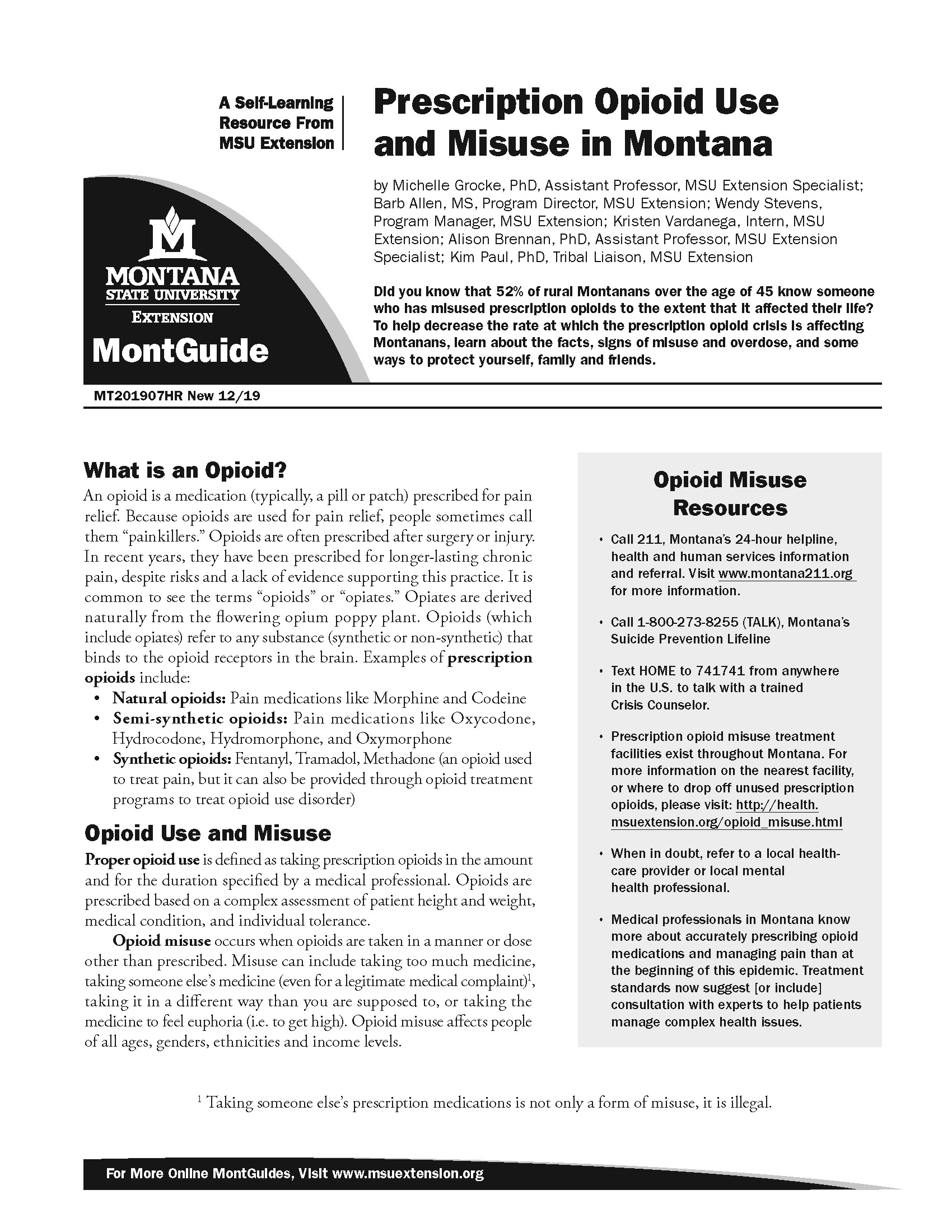
Read this self-learning MontGuide from Montana State University - Prescription Opioid Use and Misuse in Montana
Some substances that are not prescription opioids can still affect the body in similar ways and carry similar risks. One example is kratom.
What is kratom?
Kratom is a tropical tree that grows in Southeast Asia. In recent years, more people in the United States have started using it as a drug that affects the mind and body.
How kratom is used
Kratom is sold in different forms, such as capsules, pills, liquids, and powders. Some people chew the leaves, smoke them, or make tea.
Why there are concerns
Kratom affects the same parts of the brain as opioids like morphine. This means it can have similar risks, such as addiction and misuse. Some kratom products have been found to contain harmful metals. Kratom is not approved by the FDA for medical use.
Some products claim kratom can treat opioid addiction or other health problems, but there is no strong science to prove this.
Effects depend on the amount used
- Small amounts may increase energy or make a person feel more alert
- Larger amounts may make a person feel very relaxed or reduce pain
- Some people have withdrawal symptoms when they stop using kratom
Possible side effects
Mild effects:
- Nausea
- Sweating
- Constipation
Serious effects:
- Seizures
- Seeing or hearing things that are not there
- Severe mental health problems
- Addiction
- Needing more to get the same effect
- Withdrawal symptoms
- Death
FDA warning and laws
The FDA has warned people about the risks of kratom and has linked it to deaths, often when used with other substances like opioids, alcohol, or certain medicines.
Kratom is illegal in some states. In Montana, it is legal but not regulated.
Bottom line
Kratom is not always safe. Its effects and risks can vary a lot. People should talk to a doctor before using it, especially if they take other medicines. Mixing kratom with other substances can raise the risk of serious harm or overdose.
Coming Soon: Kratom: Effects of Use and Potential Risks
Kratom is a plant-derived substance that has gained attention for its wide range of effects and potential risks. In this video, Montana 406 Recovery addiction psychiatrists Dr. Bob Sise and Dr. Ty Reidenbaugh take a closer look at what kratom is, how it’s used, and what you should know before considering it.